

My bio, “just the facts” version:
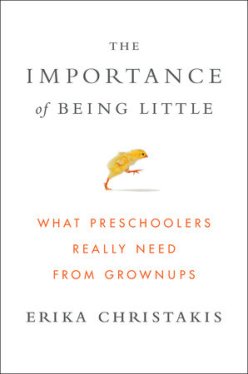
- I have a new book coming out on February 9th, The Importance of Being Little: What Preschoolers Really Need From Grownups (forthcoming, winter, 2016, Viking/Penguin: see more here.
- Lecturer on Early Childhood Education, Yale Child Study Center
- Massacusetts-certified teacher (pre K-2nd grade)
- Licensed Preschool director
- Occasional journalist (TIME.com, Washington Post, Boston Globe, etc.
- Semi-marketable letters after my name: A.B., Harvard College (anthropology); M.P.H, Johns Hopkins University (public health); M.A., University of Pennsylvania (communication), M.Ed., Lesley University (early childhood education)
- Rewarding career at the intersection of children, society, and schools (including long stint in parent volunteer vortex).

My Bio, narrative version:
I’ve spent many years — as a teacher, parent, preschool director, public health professional, college administrator, and now Lecturer in early childhood education at the Yale Child Study Center – trying to understand the impact of cultural and political forces on young people. I’m generally concerned with the things that shape young lives: politics, school boards, scientific findings , media, parents, religious institutions, and so on. You can find most of my work on children/young adults under the heading, Kids These Days (above) and my collection of posts related to women’s issues at The XX Report. For two years, I was a regular contributor to the Ideas page at TIME.com (occasionally sharing a byline there with my husband). I’ve published a few opinion pieces for CNN.com, the Financial Times, Boston Globe, WBUR’s Cognoscenti, Washington Post, and elsewhere. Here’s my take on child development, the importance of empathy, the politics of breast cancer, sex trafficking, why summer camp is a good thing, the death penalty, birth control, college binge drinking, my inexplicable Kristen Stewart crush, school shootings, and other topics here and here and here and here. I try to cast a wide net with my thinking, but I always come back to certain themes: How do we balance collective and individual responsibilities? What happens when children’s and adults’ interests collide? How do we live in a plural society without resorting to fist fights?
Spending an adult life with young people, as I’ve done, offers a weird mix of sublime and mundane. It’s impossible not to feel moved by the freshness and honesty of children’s dreams. It’s equally impossible not to feel burdened by the headaches and minutiae of shepherding kids into some semblance of adulthood. Most days, I try to focus on the dreams, not the headaches. Thanks for coming to my website. I’ve always enjoyed writing and it helps to imagine an audience, so please accept my sincerest thanks for stopping by.
Yours truly, Erika

 Erika Christakis
Love the new blog, Erika! I look forward to reading your posts!
You write so well, I am envious! Hard-hitting, funny and from the heart. Love it.
I came across your blog fortuitously as I was taking a break from studying (read: procrastinating) and checking out articles on various news sites. I also have a rather unmarketable bachelor’s (psychology and Spanish) and am currently pursuing a hopefully-marketable graduate degree (MPH in Behavioral Sciences and Health Education at Emory). It’s wonderful to read articles written by someone who has the same degree that I’ll be getting and writes with a fresh voice about topics that really interest me (e.g. women, adolescents, sexuality, education). My intended break was just supposed to be 15-20 minutes, but because of your blog it has lasted about an hour, so thank you for diverting me from my fascinating studies of epidemiology. I normally never comment on blogs but can’t resist commenting here, just to let you know that you have a new fan in Atlanta (who still reps the Midwest) who is looking forward to reading more of your work.
Hi, Thanks for the feedback! I really appreciate it and am glad to hear from a fellow MPH-er. I’ve found it a very useful degree – mainly as training to think critically about things. Best of luck to you with those epi studies!
Lots of great content here. Can’t wait to read more of your stuff.
I have really enjoy reading your blog Erika. Keep writing, because Ill keep reading!
*enjoyed
Thanks so much, Holly!! One of these days I’m going to join the world and get on facebook.
I love this blog, it’s in my bookmarks! You have such great insights and your delivery is often laugh out loud hilarious. Can you write something about your own parenting strategies, skills, and struggles? I read your dolphin mother article, but I want to read more!
I was glad to see that I wasn’t the only one wondering why Ms. Klein was a bus monitor if she couldn’t control the students. According to her, the taunting had been going on for around six months. I also questioned the fact that the bus driver didn’t take any action. And, finally, I have to question the total lack of respect for an adult. It is bad enough for one child to bully another but, as my sister and I discussed, we had to learn how to deal with it when we were bullied (back in the 50’s) but that a 13 year old would even have the audacity to speak to an adult like that! That shows a serious lack of discipline in their upbringing. During my childhood, I NEVER heard a child talk back to an adult let alone ridicule one! What is happening to our society?
Thank you for having the balls to discuss the overwhelming maleness of violence. As the sister of four brothers and a violent father I know first hand the impact of being removed from that environment by our mother. The boys were old enough to understand domestic violence but young enough to learn never to react like their father. My mother, sister and I were instrumental in that effort. It is essential that our young men learn to channel their natural tendencies for good and not evil. There is no doubt in my mind that had my father remained in our house some of my brothers would have followed his lead. Thank God for women.
It was so nice to read your clear headed article on men and mass murder.Most are hardly random, i am a firm believer in for everything a cause.Depression,bullying are but a few of these causes.
I have had the unpleasant experiance of dealing with the medical profession thru these areas and i can say without hesitation 90% of have no clue in how to deal with depression.In their defence though it is one of been there done that requirements they simply have not had.These problems will continue until people like yourself,myself and others bring them to the forefront.
Thank you for your article
Joseph Beaudin
I know you don’t care abou IQ.
The problem, which you fail to grasp, is that you don’t care about presenting an accurate story to your readers. You don’t care about being respsonsible to the Fourth Estate and you feel no obligation to fact check a story.
I see this often.
Yes, he recorded a 61, but had 5-6 other tests showing him above 70. Did you look? Did you care? No. And you have no remorse in saying that you don’t care.
My opinion is that it is important to care about truth and the facts.
Just because you want the death penalty gone should not be your justification for being irresponsible.
But, it seems you believe otherwise.
The point of my opinion piece was that I believe a person’s IQ is irrelevant to the death penalty debate. I stated clearly that any attempts to justify executions on grounds such as intelligence, family background, race, inadequacy of legal counsel etc. are a sham. The system is bankrupt, both financially and legally, not to mention morally.
However, on the narrow issue that seems to engage your interest so powerfully, it’s true I did not list the “5-6 other tests” that apparently showed a range of IQ numbers between 61 and 73. In what way were my “facts” wrong? He had a measured IQ of 61. The fact that it was measured 12 points higher is an almost laughable piece of evidence to present. You’re not seriously suggesting he is somehow a normally cognitive functioning person, are you? Even the state of Texas does not deny that the condemned man is ‘retarded’ – only whether he is retarded “enough.” Leaving aside all the other arguments for or against the death penalty, it seems like an awfully harsh system that can cherry pick which IQ results it uses to justify a person’s murder. I, for one, wouldn’t have such confidence in the validity or reliability of most testing to put a life in the balance.
On the issue of wealth you mention, below: There is a large body of research on the way that poverty disadvantages criminal defendants, not least because they often have such grossly incompetent legal counsel whereas wealthy people can buy their way out of a death sentence. As Allen Dershowitz infamously noted many years ago, you’re much more likely to end up on death row — controlling for variation in crime rates among different kinds of people — if you are “dumb, poor, and black.” How, exactly, do your ‘fact finders’ account for that? Surely you understand that we have a strong but nonetheless imperfect system, enacted by imperfect human beings, and its results do not always produce “justice.” You might want to read this shocking story of an innocent man who was executed due to a mistaken identity case that could have been solved by Nancy Drew:
http://www.theatlantic.com/national/archive/2012/05/yes-america-we-have-executed-an-innocent-man/257106/.
One day, these arguments will become moot. Society will no longer want to commit resources to executions that could be better spent on building schools. Life in prison without parole works.
so much positivity here. congrats for creating this beautiful place. cheers!
Wow, thanks very much!! I so appreciate your feedback. (I’m afraid there’s some snark here, too, if you nose around…)
Nice. The longer version especially. Best ~kl
Erica, you are right, the system need overhauling. I know this because there are a lot of people who suffer from mental disabilities, who should not be imprisoned some are not able to function, or have the ability to know what is right and wrong. We need a better mental health system and the courts need to change their present routine of just punish and more punishment. That thing needs to be changed. You are right the system is corrupt and needs to be changed, so everyone is judged justly. Then, maybe, I will believe in our legal system.To convict someone on circumstantial evidence is ridiculous and not fair. Where happened to reasonable doubt., or the evidence to back it up. Look how many have wrongly accused, then released after DNA proved them innocent. Prosecutors are to quickly to judge without enough evidence.
OK, I’m hooked! Now to go back and read more of your posts. Congratulations on being Freshly Pressed!
I was so surprised and thrilled to find your article on the maleness of violence, as NO ONE speaks about it. It’s not ‘our society’, or ‘young people’, or ‘we’ who commit violent acts..it’s males. How do we get this to be a topic of conversation ‘out there in the world’, so that we
can find ways to intervene with young males?
Thanks for commenting. I was disheartened by the response from many, implying that acknowledging the “maleness” of violence is in some way an attack on men or masculinity. On the contrary, it was always my concern about men (who are, after all, the majority of victims of violence) that drove my interest in the epidemiology of violence. We ignore this at our peril.
Hi,
I enjoyed your article on male mass homicide. I’ve stated a few times, to the anger of my white male friends, that mass homicides committed without a cause – – meaning, it wasn’t done as a terrorists act like the one experienced in Boston – – seem to be perpetrated by white males. Disproportionately so considering the percentage of the population they represent. I am speaking of cases in the United States. I know that the recent Navy yard shooter was African American and the shooter at Virginia Tech was Asian.
Perhaps i am wrong – – I need to do a quick study to analyze this observation. My white male friends, who are mostly conservative say. . .it is because the media doesn’t report every time a black man kills someone in the inner city. To which I reply. . .inner city murders tend not to be mass homicides. Also one could argue murder that happens in the inner city as it pertains to gang violence is part of the culture and thus learned and not unexpected. The white men committing mass homicide haven’t been exposed to a “gang” type culture in which the average life expectancy is only 26.
All that to say, I like your article and I am not surprised to hear that you have had many people be angry at you for pointing out the fact that mass homicides tend to involve a male. Every white man I speak with about my theory reacts with anger, as if I am attacking him personally.
Hi Erika!
I am a student of Sociology and Anthropology based in Pakistan and presently contemplating doing my thesis on the lack of public sanitation facilities for urban females. I just read your article that touches on the topic from a feminist perspective and I was wondering if you’d be kind enough to share some literature/your views on it with me via email?
If you have some time, of course!
With regards,
Nuzhat.
so sorry I missed this!! I’ve just replied to you by email…
I would be thrilled if you and your husband would consider creating your own facebook pages. I purposely “like” certain pages to receive information I’m interested in & I’d love to get a steady stream of your views and guidance via Facebook (out of convenience) as well as your husbands (just ordered Connected) Many thanks!
I’m a little behind the times with Facebook but am trying to up my game more with Twitter. I’m working on a book about young children that will be published by Viking Penguin in about 18 months and will definitely have joined the 21st century by then. Thanks for the feedback!